Showing posts with label technology. Show all posts

Friday, September 26, 2008

Jon D. Wilson, Prosthetic and Orthotic Leader in St. Louis and Beyond

John D. Wilson, CPO, LPO, helped found P & O Care just over six years ago with Jim Weber; since then he has served as its Clinical Director, being both a prosthetist and an orthotist. Jon has a total of over 16 years experience in the field. He graduated from the Certificate Programs in Prosthetics and in Orthotics from the Northwestern University Medical School and then earned his ABC Certification in Prosthetics in 1996.

Later, after working as a prosthetist in St. Louis for a few years, Jon went back to Northwestern for his Orthotics certification and completed his residency in the fall of 2003. Whereas the State of Missouri does not require licensure in the O & P field, Jon is currently a Licensed Prosthetist and Orthotist under the State of Illinois Department of Professional Regulation.

Besides leading P & O Care’s team of nine prosthetists and orthotists here in St. Louis, Jon has been recognized as a national leader in the field of upper and lower extremity prosthetic care. In 2004, he was awarded the prestigious Howard R. Thranhardt Lecture Honorarium for his abstract “A New Concept in Prosthetic Interface Design for Hemicorporectomy Amputees Utilizing ROHO Compression Therapy.” Jon’s new invention, which utilizes a matrix of ROHO cushions inside a custom fabricated “bucket” prosthesis, enables people who have literally been cut in half to float in a seated position. With their weight and body fluid evenly distributed, they are able to lead active, mobile lives without worrying about skin breakdown. Users can get around on their own in a wheel chair (or skateboard!), and some have even driven long distances alone, instead of lying in bed.

Wednesday, July 9, 2008

Oregon Mill Accident Victim Fit with iLimb Hand

Silverton man learning to live with bionic hand

Silverton man learning to live with bionic hand

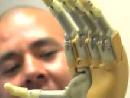
James Bristol of Silverton shows his new bionic right arm.

By KATU Web Staff

PORTLAND, Ore. - A Silverton man who lost his right hand in a mill accident is now one of the first people in Oregon to be fitted with a bionic hand.

James Bristol lost his hand about a year ago. Thanks to the revolutionary i-LIMB technology, his new bionic hand looks and acts like a human one.

Five individual motors power each finger, giving patients more maneuverability.

Bristol is now in the process of re-training his brain and his body using his new hand.

"You know you lose it and suddenly you are plunged into a whole new realm of doing things," he said. "So learning, you feel like a little kid that's learning to walk again."

The i-LIMB was launched last summer. Wounded soldiers from Iraq and Afghanistan are also being fitted with the prosthetic.

The hand can cost anywhere between $50,000 and $80,000.

Tuesday, May 13, 2008

St. Louis Prosthetists Get Accredited in iHand and Proprio Foot

ABC Certified Prosthetists from P & O Care have become the only accredited providers of the new iHand in the St. Louis Region. Dan Luitjohan and Manny Rivera attended a course April 2 in Chicago put on by iHand's manufacturer, Touch Bionics, from Scottland. The iHand is the first prosthetic hand with individually moving digits, so it can hold a penny or a business card, turn a key in a lock, munch cell phone keys, or pick up a mug of coffee. Plus, it looks and moves much more naturally. The only downside: it costs a lot and is not covered yet by Medicare or private insurance.


All of P & O Care's five prosthetists, including Jon Wilson, Greg Doerr, and Maggie Ware-Smith, have become accredited in the new Proprio Foot by the manufacturer Ossur. The Proprio offers is the first "bionic" ancle, with computerized sensors and a tiny motor that adjusts the angle of the foot to the angle of the incline on which a person is walking. Clinical Director Jon Wilson jokes, "Now, I can give you a foot that you can get up with in the middle of the night, and if you stub your toe, you can say, 'Ouch!'"

That's going a little too far, but the Proprio enables below-knee amputees to walk much more naturally up and down ramps and hills or over uneven terrain than they could with even the best traditional non-bionic foot. Unfortunately, the Proprio is also expensive and difficult so far to get third party payment for, but that may be changing soon. It's also heavier than most feet, a little over two pounds, which means it would not be the best option for a lower-activity level individual.

Thursday, February 21, 2008

Knee Brace Could Generate Enough Power for Electronic Prosthetics

Just like a hybrid auto engine generates electricity while a car rolls to a stop, a new knee brace works by creating resistance when the leg stops with each step. Already the prototype can power a cell phone. Later versions may be able to power computerized and motorized prosthetic knees on the opposite leg.

Such knees are already on the market. Otto Bock's C-Leg uses a computer chip to control hydrolic fluid, thus regulating the speed and resistance on a prosthetic knee. A much heavier, bulkier knee, Ossur's Power Knee, has a motor that powers the lower leg and bluetooth chips that pick up signals from the sound leg. The problems with all of these designs are that they need to be plugged in overnight and the batteries add weight and bulk, something many older amputees cannot tolerate.

If hopes for this new power-generating brace work out, it would provide the electricity for these devices so they can become much smaller, lighter, and versatile.

Friday, January 25, 2008

CNN: Marine Walks with Bluetooth Technology

CNN has a good story on its front page right now about a Marine walking with Ossur's Power Knee on both sides. The two motorized and computerized legs communicate with each other using Bluetooth technology, just like our cell phones and ear buds. There is also a great video to go with the story.

Not mentioned in the CNN story: The Power Knee is still too heavy for most individuals to walk with successfully, but as the technology shrinks, there is hope that it might enable amputees with limited energy to walk greater distances than traditional prosthetics.

Wednesday, January 9, 2008

Scotland joins arms race with superhuman strength

By Kate Foster

A TEAM of Scottish scientists has produced an artificial arm that is more powerful than the real thing. The superhuman arm, for patients who need an artificial limb, can lift heavier weights than the average person is capable of and will only fatigue when its batteries run out.

The i-Limb System arm has been developed by researchers at prosthetics firm Touch Bionics, which last year launched the most advanced artificial hand in the world. The Livingston-based firm specialises in hi-tech limbs for patients who have undergone amputations or were born with limbs missing. The researchers say their new arm is capable of repeatedly lifting a weight of 10kg up above head height and could do so all day, compared with the average human being who would tire within minutes. The wrists could rotate 360° and anyone using it could perform hundreds of push-ups.

However, the sheer power of the limb means its creators are faced with the problem of deciding which patients could be trusted to use it safely, as it has the potential to be used as a weapon.The arm was developed by David Gow, director of rehabilitation engineering services at NHS Lothian, who has worked with hundreds of patients at the South-east Mobility and Rehabilitation Technology Centre at the Astley Ainslie Hospital in Edinburgh.Gow is also the director of technology for Touch Bionics, which researches and develops state-of-the-art technology.

He told Scotland on Sunday that the arm is at the prototype stage and is undergoing further fine-tuning in order to make it available to patients.He said: "The i-Limb system is better than a human arm. It is faster and can lift heavier weights than a human arm. It also looks good, has smooth movement, and operates with less noise than existing prosthetic arms. The technology is new and evolving. "However, we might have to scale the power down to make it suitable for everyone. With something that has a better than human performance, our challenge is ethical. "A patient would have the potential to hurt themselves or other people with it as it is actually better than a human arm. It could do damage. "We have got to take safety very seriously. You have to attach it to the patient's body and that could cause damage if the weight is too heavy. It could snap their ribs. And it could be pretty scary flapping about."

Scientists have spent years researching how to create robots that can surpass human performance. The i–Limb System is the latest in a long line of bionic body parts to have been created in laboratories just two or three decades after they were merely the stuff of science fiction.

The arm, which is worn in a harness, is controlled by electrical signals that come from the user's own body. Electrodes are placed on the skin on the user's chest which pick up minute signals from the muscles. The user is taught how to move these muscles to send electrical signals which control motors inside the arm such as wrist rotation and elbow movement. It is powered by lithium-ion batteries which can be recharged overnight. The i-Limb System will be covered in a realistic cosmetic skin.

Tuesday, November 20, 2007

Neuroscientists Uncover Brain Region Involved in Voluntary Behavior

Scientists at the California Institute of Technology have deciphered the activity of an area of the brain that could one day prove vital in the development of neural prostheses--within-the-brain implants that would translate thought into movement in paralyzed patients. The results of this study were published as the featured article in the November 8 issue of Neuron...

The experiment shows that it is "the monkey's own choice that activates these areas," says Cui, and not the sensory stimuli provided by the visual target it sees on the computer screen. This finding is significant, Andersen says, because "this is the earliest stage in the brain found so far that is actively related to movement plans." ...

The lab is working toward the development of implanted neural prosthetic devices that would serve as an interface between severely paralyzed individuals' brain signals and their artificial limbs--allowing thoughts to control movement. To assist in designing a more optimal prosthetic, they are now examining whether the decision to make a reaching motion is first made in PRR, or is made in another area of the brain and then transferred to PRR to form the movement plan.

Monday, November 5, 2007

American Healthfront


P&O Care recently appeared in a segment of American Healthfront on St. Louis NBC affiliate KMOV4. The two minute segment features two of our prosthetists, Jon Wilson and Greg Doerr, as well as two of their patients, Denise and Sharon.

Tuesday, October 30, 2007

Healthlink Outtakes

Have you ever wondered what it's like to film a commercial? Check out this authentic behind-the-scenes peek at the filming of our two-minute news clip that appeared on KMOV4's "American Healthfront" September 6, 2007. It might make you laugh.

Thursday, October 11, 2007

Government Research Continues on Arm Prostheses

Over the past ten years or so, the increasing prevalence of type 2 diabetes in our society has led to more resources being devoted to research and development of better below-the-knee prostheses. Not so with the field of arm prosthetics. Too few people across the United States loose their arms, compared with those who loose legs, to make significant investment profitable.

Now, prompted by veterans returning from Iraq and Afghanistan, a government agency known as DARPA within the Pentagon has begun funding new initiatives to make natural, lighter weight, more versatile prosthetic arms.

There is an excellent article in The Boston Globe on one of these new arms still in development. Here is an excerpt about the inventor:

Kamen hopes the market for the product won't get too big. But he's gratified to see the arms being used by patients, and he brags like a proud parent about what they can do with them. For example, one patient shows off by picking up individual M&Ms, and another can use a power drill. "We've given them a new perspective on life," Kamen said.

Friday, September 21, 2007

Robotic Prosthetics

Tuesday, August 21, 2007

Rocket-powered Mechanical Arm Could Revolutionize Prosthetics

[This is no joke.]

Science Daily — Combine a mechanical arm with a miniature rocket motor: The result is a prosthetic device that is the closest thing yet to a bionic arm.

A prototype of this radical design has been successfully developed and tested by a team of mechanical engineers at Vanderbilt University as part of a $30 million federal program to develop advanced prosthetic devices.

"Our design does not have superhuman strength or capability, but it is closer in terms of function and power to a human arm than any previous prosthetic device that is self-powered and weighs about the same as a natural arm," says Michael Goldfarb, the professor of mechanical engineering who is leading the effort.

Read the full original article at http://www.sciencedaily.com/releases/2007/08/070820130638.htm.

Friday, August 3, 2007

Hemicorporectomy Prosthesis Discovered

For Michael Mason's last story, he had to travel to Baghdad. His article "Iraq's Medical Meltdown" appeared in the July issue of Discover Magazine. This time, Michael came to St. Louis. He is working on a story about one of the most radical surgeries anyone could undergo: hemicorporectomy, which in plain English means the body gets cut in half, right below the belly button.


Last Friday, Mason was in town interviewing Dr. Frank Johnson at St. Louis University, who performs the procedure, and Jon Wilson, CPO, at P&O Care, who has developed a prosthesis that helps these amputees live normal lives. Saturday, he was on to Kansas City to visit one of their patients living with the device, John Neill. Shaped like a bucket and lined with ROHO cushions to distribute pressure, the prosthesis enables hemicorporectomy, or trans-lumbar, amputees to sit upright, walk with their hands, and even drive a car. Without it, they would be confined to a bed, where they could develop the same sores that often caused their amputation.

Jon Wilson’s abstract, “A New Concept in Prosthetic Interface Design For Hemicorporectomy Amputees Utilizing ROHO Comprehension Therapy: A Case Study for a Prosthetist’s Perspective,” received the prestigious Howard R. Thranhardt Lecture Honorarium for the American Orthotic and Prosthetic Association. Look for Michael Mason's story about hemicorporectomy in the September or October editions of Discover Magazine, which is currently read by about two million people every month.

Get a Grip

The first prosthetic hand with individually moving fingers is now on the market. Think: Luke Skywalker at the end of The Empire Strikes Back. Myoelectric prosthetic arms and hands have sensors that pick up electric impulses from the muscles of the arm. Until now, those impulses have been able to open or close a hand, control grip strength, and rotate a wrist or elbow. But the i-Limb hand by Touch Bionics in Scotland has tiny motors for all four fingers and thumb. With it, amputees can pick up a coin, turn a key, punch keys on a cell phone, or lift a coffee mug.


Touch Bionics released the i-Limb July 29 in Vancouver, British Columbia, at the World Congress of the International Society for Prosthetics and Orthotics. There's no word yet on whether Medicare or insurance companies in the US are going to pay for the i-Limb hand, so unfortunately, distribution is limited to people who want to pay out of pocket.

Thursday, August 2, 2007

Run, Oscar, Run!

The most famous amputee in the world right now is perhaps South African sprinter Oscar Pistorius. The Paralympic world record holder in the 100, 200, and 400 meter races is trying to qualify to represent his country in the 2008 Olympic Games in Beijing, China, but not without protest from the IAAF, which governs the Olympics. Some people worry that Pistorius' two prosthetic feet give him an unfair advantage over able-bodied athletes. Tests are now being done, and the outcome will determine if Oscar gets to compete against the most elite runners in the world or if he'll have to stick to racing against other amputees.

Oscar Pistorius doesn't have calves. His J-Shaped "Cheetas," passive prosthetic feet powered entirely by his quadriceps, mimic the spring of the human foot and achilles tendon. But whereas the spring in the our step can return over 200% of the energy we put into it, Pistorius' feet only return less than 95% energy, because he has no calves. One objection claims that Oscar's prostheses don't fill with lactic acid during a race like an able-bodied runner, but weakening calves still provide more energy than the best passive mechanical device. Other objections state that Pistorius' legs are more aerodynamic than human legs and don't use energy from his body. However, gait studies have always shown that below-the-knee amputees actually burn more calories and use more oxygen moving the same distance as able-bodied people. Again, the man has no calves! He's so slow exploding out the blocks that the second half of his lap is actually faster than his first.

The PowerFoot One prosthetic foot, recently manufactured by iWalk, actually incorporates computer processors and battery-powered motors to replace the function of the calf and achilles tendon. This and other bionic devises like Ossur's Power Knee promise to enhance the prosthetic industry, if their size, weight, and price can ever come down. When that day comes, that IAAF better watch out! But until then, there's no way that passive prosthetic feet like the ones Oscar Pistorius wears could give anyone an unfair advantage over sprinters with calves.

Thursday, February 1, 2007

Ossur Introduces New Computerized Foot

There is a new prosthetic foot on the market that claims to be able to think for itself. The Proprio Foot by Ossur utilizes a small motor, computer chip, and complex software to create a more natural gate for active, below-knee amputees.


Until now, a wide variety of prosthetic feet have been designed for various activities from walking around the house to competing in track and field events. Meticulously crafted components such as carbon fiber springs and rubber bumpers make many prosthetic feet similar to human feet in the way they transfer energy, absorb shock, and rotate at the ankle for better stability. But the Proprio Foot can automatically lift the toe just the right amount depending on what a person is doing, something no other foot can do.

Something as simple as sitting in a chair can look very awkward if your toe is always pointing up in to the air, so the Proprio Foot automatically lowers the toe when sitting. Additionally, when some amputees walk, they make a little more effort to keep the toe of their prosthetic foot from dragging the ground. By automatically lifting the toe at just the right moment in a person's stride, the Proprio Foot removes the limp associated with this now-unnecessary thought process.

The Proprio Foot costs between $12,000 and $18,000 and is not yet covered by Medicare, Medicaid, or insurance companies in the United States.

Osseointegration Offers Promise, Problems

Osseointegration is a surgical procedure in which a titanium rod is implanted into bone. It has been used for some time in dental and facial prostheses, and efforts are not underway in Europe to perfect the technology for trans-femoral, above-the-knee amputees.

Titanium implants are so promising because the human body almost never rejects one as a foreign object, as sometimes happens with other implants and transplants. As the bone heals, it integrates fully with the titanium rod screwed into it. As a result, a prosthesis can be attached easily without the need to fabricate a custom socket around an amputee's residual limb.

Over the past several years, advances in prosthetic science have enabled prosthetists to make sockets that fit much more comfortably than in the past. Still, a few amputees have a difficult time wearing their prosthesis because of chronic pain or decreased circulation. For them, osseointegration offers a big improvement. However, the procedure has been most successful in younger, healthier people whose bones heal best.

The two greatest barriers to the complete success of osseointegration technology seems to be loosening within the bone cased by the stress of walking, and infection at the site where the implant protrudes through the skin. Efforts to overcome these problems look promising.